22 June 2025
Did a series of test exposures to see which combinstation of ISO and shutter speed yield the best appearance.
Three shots at 12,800, 6400, 3200, and 1600. Shot length of 20, 10, and 5 seconds for each ISO.
Looking for star trails, which is not what I want to see right now.
Discovered that with the Sony G PZ lens, 1600 ISO at 5 seconds provides the best appearance of all the images.
That provides a starting point. This experiment can be repeated with the same lens at different apertures, different lenses, locations, or sky brightness.
The point is to provide a solid basis for educated decisions regarding the “best” exposure settings for each lens in different situations.
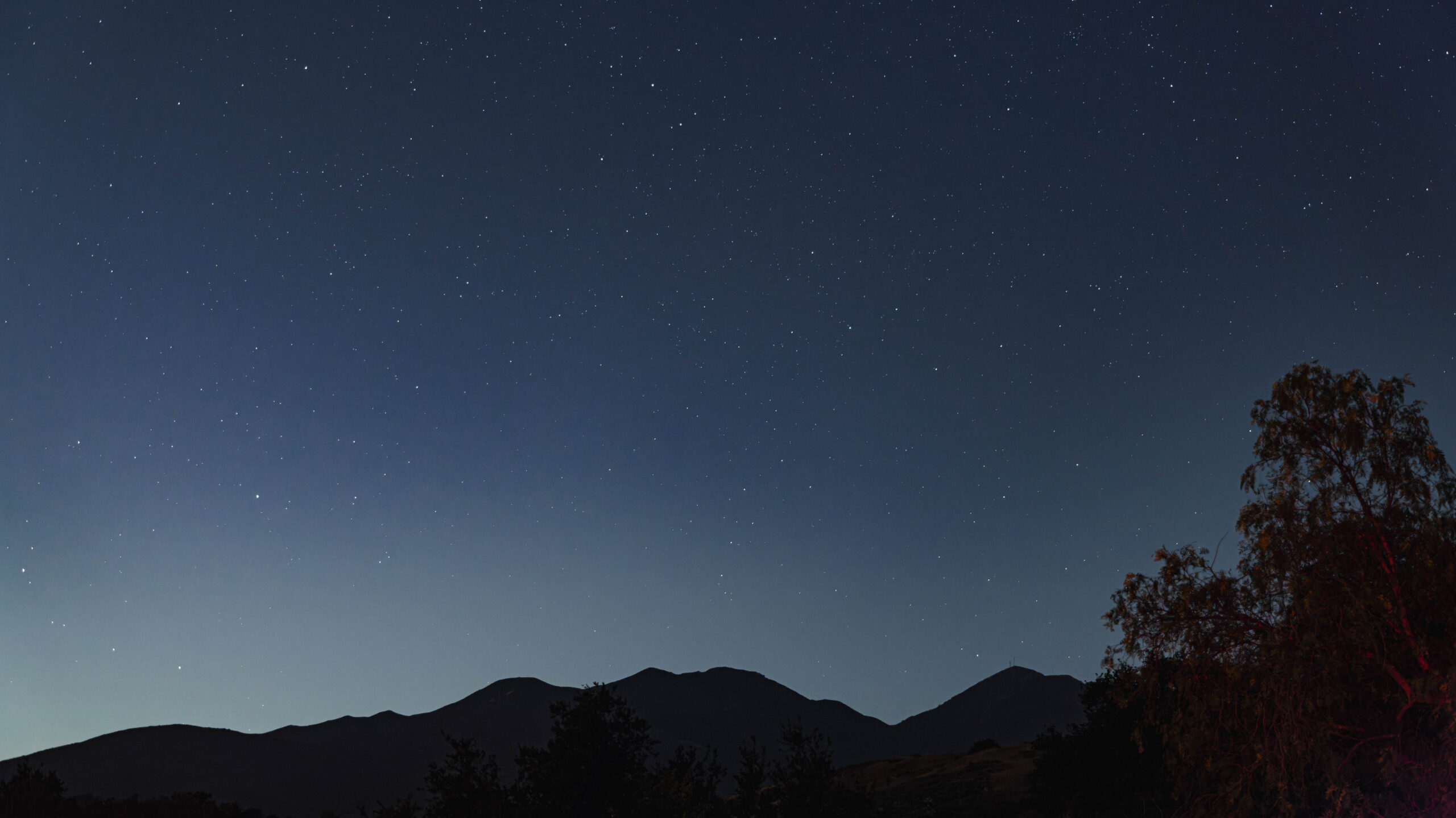
Here’s a 5 second exposure, ISO 1600, 49mm, f/4, Sony G PZ lens, view of Saddleback during this first session:

It’s not easy to see on a phone, but the stars are nicely pinpointed, so the infinity focus is correct. This was developed in Lightroom Classic, using AI Noise Reduction. Pretty amazing how well that works.
Below is an enhanced version, created to pop out the sky with more detail, using Lightroom. The ability to manipulate RAW photos is endlessly pleasing.

If you’re looking at this on a phone or tablet, try turning the device to landscape, then pinch zoom on the image to magnify it.
Finally, below is the same image modified in DaVinci Resolve using AI Magic Mask. The sky was masked, preserving its quality, and the landscape manipulated.
There is some banding going on, since this is a PNG image, and is several steps away from the quality of the original RAW image.

Below is the histogram from DaVinci Resolve’s Color section for the image above.
