-
Golden Hour, Blue Hour, Twilight – Mastery
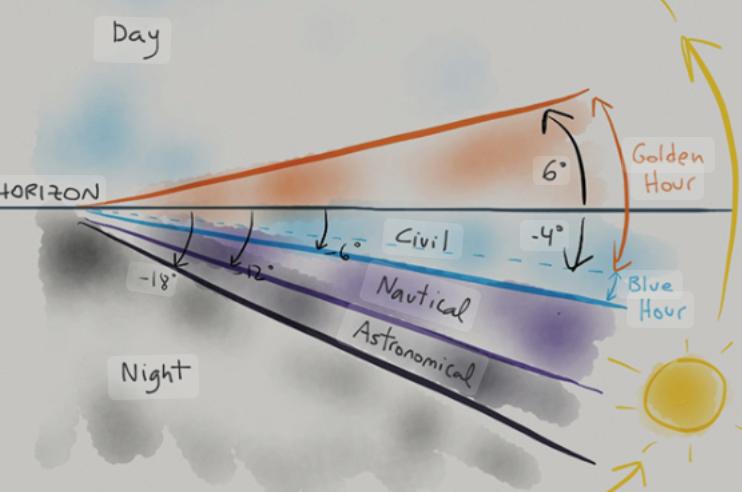
The available light from the Sun varies with the time of day. We can differentiate 7 periods of time: Other than Blue Hour, each can be divided into degrees based on the elevation angle, as follows: Daytime is greater than 6 degrees elevation angle.Nighttime is greater than negative 18 degrees. Finding the degrees is simple…
-
Camera and Exposure Settings for Astro
File Format: Shoot in RAW White Balance: Set to Daylight or a Kelvin between 3800 and 4400. Never use Auto White Balance. Auto-ISO: Turn it OFF. Image Stabilization: OFF Noise Reduction: Turn off long exposure NR. Perform NR in post production. LCD Brightness: Dim the LCD to lowest level to save your night vision.
-
How To Choose The Best Exposure Settings For Astrophotography
This is an exercise. Tip: Repeat this excercise with the same lens and different apertures, different lenses, or locations with different sky brightness. This will provide a solid basis for educated decisions on “best” exposure settings for each lens in different situations. NOTE: This seems to be overkill with the Sony. The exposure is almost…
-
Maximum Shutter Speeds Based on Rule of 300
Camera sensors have vastly improved since the “old days” of the Rule of 500. This was an early attempt to estimate the longest shutter speed for a specific focal length lens. You divide the number 500 by the focal length, and that’s your max shutter speed. For example 500 divided by a lens length of…
-
Histogram Notes
Understanding the camera’s histogram. The histogram shows how much of your image contains fregions of different brightness levels. Dark adapted eyes can fool you into thinking pictures are too bright when they’re not. Choose exposure setting so histogram is shifted as far to the right as possible without overexposing the sky or other bright subjects…
-
Celestial Coordinates
Recall that latitude and longitude are the coordinates used to locate objects on earth’s surface. Any point on earth can be identified by these coordinates. Astronomers use a similar system to map the sky, as follows: Declination and right ascension are the astronomical equivalents of latitude and longitude. Dec (Declination) = Latitude RA (right ascension)…
-
Astrophotography: Two Types
There are two types of astrophotography: deep-sky and landscape. Deep Sky Astrophotography Landscape Astrophotography The celestial poles are directly above the earth’s north and south poles. The North Star is Polaris, and sits almost exactly at the north celestial pole. There is no “south star.” The celestial equator is simply the projection of the earth’s…